
Jaipur • New Delhi • Bengaluru • Guwahati • Kolkata
D. Ravinder

The book examines the repercussions of the neoliberal development model, uncovering disparities in resource distribution among states and social strata. It scrutinizes the efficacy of existing policies, often deemed arbitrary, ad-hoc, and unsustainable. Exploring diverse aspects of public policy, rural development, socio-economic policies, and democratic decentralization, the volume meticulously analyzes topics such as poverty eradication, rural development programmes, the Backward Classes Movement, and the challenges of decentralization, particularly in the South Indian State – erstwhile Andhra Pradesh. Additionally, it investigates the influence of liberalization on agriculture and forestry policies, presenting a comprehensive overview of regional imbalances and the implementation of local area development schemes.
By incorporating three decades of research papers, this compilation provides policymakers with valuable insights into the effectiveness of development strategies. It facilitates policy reorientation and the identification of implementation gaps, contributing to the discourse on inclusive development. Emphasizing the significance of considering diverse social groups and classes, the volume aims to shape more effective public policies.
An Introductory Treatise
Section I : State, Marginalized Communities and Development
Section II: Decentralized Governance and Rural Development
D. Ravinder, a distinguished Professor of Political Science and Vice-Chancellor at Osmania University, Hyderabad, boasts a remarkable career spanning over 32 years, encompassing teaching, research, and administration. His research focus spans the Indian Political Process, Public Policy, Panchayati Raj, and Rural Development, with a prolific output of over 25 research articles in esteemed national and international journals, four edited books, and the completion of UGC research projects. He is actively engaged in addressing contemporary and socially pertinent issues through newspaper contributions and has been a notable participant in national and international conferences. Dr Ravinder, as Vice-Chancellor, championed a 21-point agenda, prioritizing quality in teaching, research, and innovative administrative practices across the university and affiliated colleges.



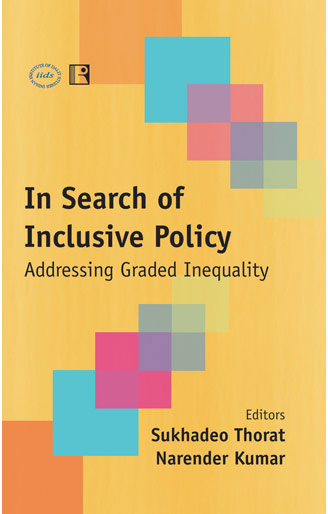
Sukhadeo Thorat and Narender Kumar (Eds.)
Your cart is empty.
