
Jaipur • New Delhi • Bengaluru • Guwahati • Kolkata
Kanekanti Chandrashekar Smitha (Ed.)

Through the analysis of Indian metropolises, this volume critiques
the reality of “entrepreneurial governance” that has emerged as a major urban
development practice in cities of the global south. In neoliberal India, the
use of management rhetoric in urban development has rapidly led to the growth
of urban/peri-urban structures and spaces that are supposedly “smart” and
“entrepreneurial”, which are networked within global systems of production,
finance, technology/ telecommunication, culture and politics.
Through diverse empirical evidence from India, particularly from
the metropolises of New Delhi, Mumbai, Bengaluru and Chennai, this volume
focuses on the fallout of the deployment of “entrepreneurial governance”
practices at national, state and local levels. Foremost, it explores the impact
of specific institutional and organizational reorientations and changing urban
spatial landscapes at the local level; secondly, it discusses the
socio-economic implications of rollback ofthe state and involvement of
non-state organizations in governance as part of urban entrepreneurialism;
further, it discusses the regulation of urban development projects by local
governments and the impact of "entrepreneurial governance" for
citizens, often resulting in social exclusion and inequality. Finally, it explores
the inherent contradictions within political and institutional landscapes that
can be described as “entrepreneurial”.
1 Entrepreneurial
Urbanism in India: A Framework K.C. Smitha
Part I: Urban Governance and
Institutions
2 Introducing
Urban Entrepreneurialism in India: An Analysis of Programmatic Interventions
Debolina
Kundu and Sudhir Krishna
3 Entrepreneurial
Governance in a Resilient City: Bengaluru, India
H.S.
Sudhira
Part II: Political Economy of
Urbanisation
4 From
Hierarchy to Heterarchy: Moving Beyond Entrepreneurial Governance. Municipal
Reforms Programme in Karnataka
Anjali
Karol Mohan
5 'Speculative
Spaces': The Material Practices of Urban Entrepreneurialism
Raman
Bhuvaneswari
6 The
Politics of Entrepreneurial Vision Group Plans and their Impact at the Local
(Government) Level, Bengaluru
Vinay
Baindur
Part III: Urban Inclusion and
Exclusion
7 Remaking
the 'mohalla': Muslim basti-dwellers and Entrepreneurial Urbanism in Mumbai
Qudsiya
Contractor
8 Fragile
Entrepreneurialism: The Mumbai Airport Slum Redevelopment Project
Xuefei
Ren
9 Planning
their Homes in Entrepreneurial City: The Capacities of Urban Poor and the
Constraints of Public Policy
Swetha
Rao Dhananka
10 Spatial
Reproduction of Urban Poverty in Entrepreneurial City: Bengaluru, India
K.C.
Smitha
Smitha
Kanekanti Chandrashekar is Research Scientist at the Centre for
Research in Urban Affairs (CRUA), Institute for Social and Economic Change,
Bengaluru, India. Her research focuses
mainly on urban governance, service delivery, urban poverty, urban informality,
urban political economy and urban political ecology. She has a PhD in Political
Science & Public Administration from the Institute for Social and Economic
Change (through the University of Mysore). Her doctoral research examined urban
governance and service delivery of water supply and sanitation in Bengaluru,
assessing the impact of neoliberal urban sector reforms on service delivery and
equity. Over the past several years, she has been actively engaged in varied
urban research projects such as structure of Indian metropolises, rural-urban
migration, urban deprivation, urban infrastructure, urban poor and urban land
governance from interdisciplinary perspective. She has published several book
chaptersand articles in peer reviewed journals.






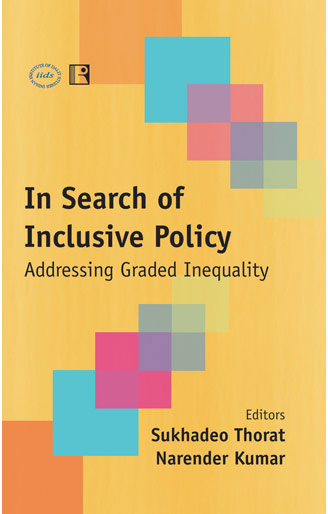
Sukhadeo Thorat and Narender Kumar (Eds.)
Your cart is empty.
