
Jaipur • New Delhi • Bengaluru • Guwahati • Kolkata
SUKHADEO THORAT

This book encapsulates the academic engagement of Sukhadeo Thorat over the past forty years. Thorat has been deeply involved in researching some of the most contentious issues of inter-group economic inequalities – particularly those linked to caste, tribe, religion, and gender–caste intersectionality.
The book presents Thorat’s lifelong research, condensed into seventeen articles, on the persistent poverty and deprivation faced by discriminated groups, and the roots of these issues in caste-based economic discrimination.
Innovatively, it offers insight into the sources and motivations behind caste economic discrimination, drawing on general economic theories of discrimination and, more specifically, theories related to caste. Based on these theoretical frameworks and a wealth of empirical evidence on caste and untouchability-based economic discrimination, the book also reflects on remedies to address this deeply rooted and enduring problem.
Additionally, it explores a conceptual framework for studying caste-based economic discrimination and its consequences for poverty among marginalised groups – a resource that will be especially valuable to young researchers.
In today’s context of growing demands for caste-, religion-, and gender-based policies, this book is both timely and essential reading for those engaged in research and policymaking on group inequalities and their remedies.
Foreword by Jean Drèze
Introduction: Academic Journey in Retrospect: From Nowhere
to Up There
Inter-Social Group Economic Inequality in Human Development
Persistence of Social Group Inequalities in Poverty and Income: Caste, Tribe and Religious Minority
Caste Inequality in Human Poverty: Poor Housing, Illiteracy, Malnutrition and Poor Health
Why Some Religious Minorities are More Deprived than Others?
Dalit Women’s Marginality: Intersectionality across Gender and Caste
Why Caste-based Economic Inequality Still Persists?
Insight from Economic Theories of Discrimination
Economic Theories of Discrimination: Sources, Motives, Impacts and Policies
Economic Theories of Caste Discrimination: Sources, Motives, Impacts and Policies
Sources of Caste Inequality: Caste Discrimination and Unequal Access to Wealth and Education
Caste and Religious Identity in Call Back for Employment
Caste Discrimination in Hiring, Wages, and its Impact on Poverty
Caste Matters in Agricultural Income, Input Use and Productivity
Role of Caste Discrimination and Wealth Inequality in Unequal Education Attainment
Measurement of Caste Discrimination: Conceptual Framework
Measuring Caste and Untouchability-Based Economic Discrimination: Concept and Indicators
Empirical Evidence on Caste and Untouchability-based Discrimination from Primary Surveys
Caste Discrimination in Rural Markets: Labour, Land, Consumer Goods and Inputs
Scheduled Castes Businesses: Caste Discrimination in Purchase of Inputs and Sale of Outputs
Caste Discrimination in Urban Rental Housing Market
Why is Conviction in Atrocities Against Scheduled Castes Low?: Caste Solidarity in Administration Matters
Remedies Against Caste Discrimination and Inequality
Empowerment Policies for Discriminated Groups: Legal, Reservation, and Reparation
Myths and Reality of Opposition to Reservation Policy
Sukhadeo Thorat, Professor Emeritus at Jawaharlal Nehru
University, New Delhi. He holds the K.R. Narayanan Chair at Mahatma Gandhi
University, Kottayam, Kerala, and was Ambedkar Chair Professor at the
University of Calicut, Kerala. He is a former Chairman of the University Grants
Commission and the Indian Council of Social Science Research, New Delhi. In
recognition of his contributions to education and his service to the deprived
sections of society, he was awarded the Padma Shri by the Government of India
in 2008.



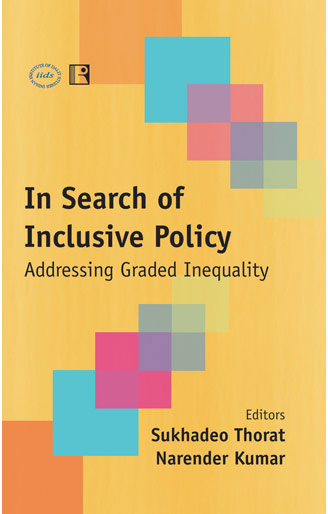
Sukhadeo Thorat and Narender Kumar (Eds.)
Your cart is empty.
