
Jaipur • New Delhi • Bengaluru • Guwahati • Kolkata
Sukhadeo Thorat | Amit Thorat
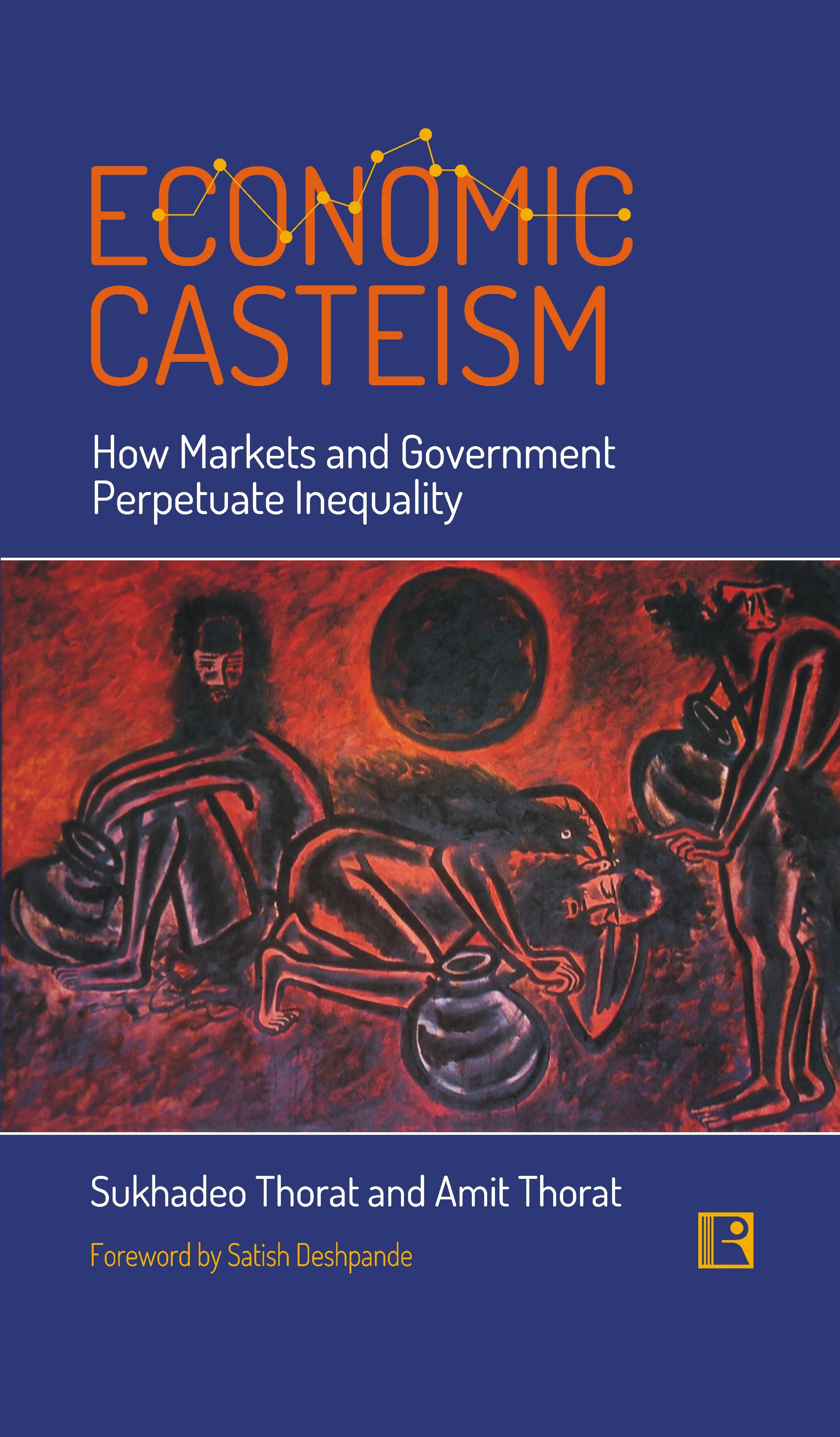
Probably for the first time, this book presents empirical evidence on caste discrimination in the functioning of rural markets in India. The analysis generates convincing empirical evidence of the caste-based discrimination faced by ex-untouchables in rural markets – in hiring, wages, the sale and purchase of land, and access to consumer goods and inputs used in farming and business. It also provides evidence of the discrimination encountered by ex-untouchables in accessing school meals for children, health services, and public employment provided by the government.
The book captures the impact of discrimination on the income of ex-untouchable wage labourers, farmers, and businesspeople. Caste norms continue to shape the economic decisions of the higher castes, to the disadvantage of ex-untouchables in market exchanges. By estimating the income loss due to discrimination, the book demonstrates its poverty-aggravating effects on ex-untouchables, and argues that affirmative action policies are essential not only for ex-untouchable wage labourers, but also for farmers and businesspeople, to ensure non-discriminatory access to markets and government services.
Most importantly, it develops an innovative theoretical and conceptual framework for studying discrimination in markets and government, which young scholars will find useful for further research.
Foreword by Satish Deshpande
Acknowledgement
Section I: Poverty of Untouchables: Theoretical and Empirical Exploration
Chapter 1: Problem of Persistent Poverty of Untouchables: Theoretical Exploration
Chapter 2: Economics of Caste and Untouchability
Chapter 3: Methodology: Concept, Indicators, Measurement, and Database
Section II: Caste Discrimination in Markets
Chapter 4: Farm Wage Labour: Discrimination in Hiring, Wages, and at Workplace
Chapter 5: Non-Farm Wage Labourers: Discrimination in Hiring, Wages, and at Workplace
Chapter 6: Regular Salaried Workers: Discrimination in Hiring, Wages, and at Workplace
Chapter 7: Untouchable Farmers: Discrimination in the Inputs and Product Markets
Chapter 8: Untouchable Entrepreneurs and Businesses: Discrimination in Inputs and Product Markets
Chapter 9: Restrictions on Free Labour, Farming, and Business: Caste Antagonism, Animosity,and Coercions
Section III: Caste Discrimination in Government
Chapter 10: Janani Suraksha Yojana (JSY): Discrimination in Delivery of Health Services
Chapter 11: Integrated Child Development Programme: Discrimination in Delivery of Health Services
Chapter 12: Mid-Day Meal: Discrimination in Delivery of Meals in Schools
Chapter 13: Employment Guarantee Scheme: Discrimination in Employment, Wages, and at Workplace
Chapter 14: Policies Against Discrimination for Labourers, Farmers, and Entrepreneurs
Sukhadeo Thorat, Professor Emeritus at Jawaharlal Nehru
University, New Delhi. He holds the K.R. Narayanan Chair at Mahatma Gandhi
University, Kottayam, Kerala, and was Ambedkar Chair Professor at the
University of Calicut, Kerala. He is a former Chairman of the University Grants
Commission and the Indian Council of Social Science Research, New Delhi. In
recognition of his contributions to education and his service to the deprived
sections of society, he was awarded the Padma Shri by the Government of India
in 2008. Amit Thorat, an economist by training, currently works at
the Centre for the Study of Regional Development, Jawaharlal Nehru University,
New Delhi. His research interests include inequality, poverty, untouchability
and discrimination, social behaviour, health and malnutrition. He has been part
of the India Human Development Survey (2012) and Social Attitudes Research for
India Survey. He has co-authored Undernutrition and Public Policy in India with
S. Desai, L. Haddad, and D. Chopra. His papers are published in international
journals such as World Development, Oxford Review of Economic Policy, Journal
of Social and Economic Development, Food Policy, Canadian Journal of
Agricultural Economics, and Economic Development and Cultural Change.

Paramjit S. Judge
Debi Chatterjee

Your cart is empty.