About the Book
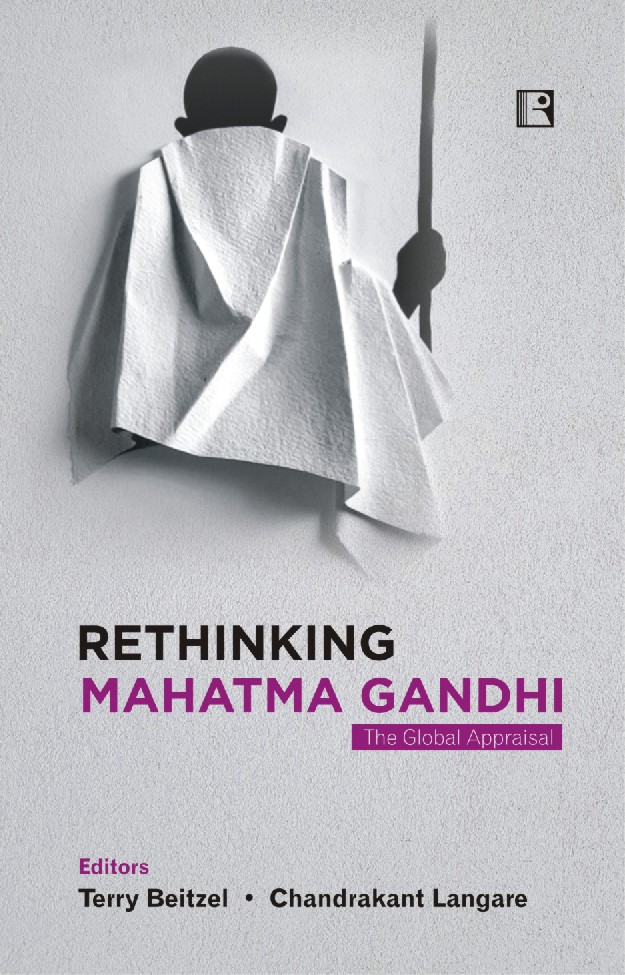
Gandhi was a colossal figure of Indian nationalism and renaissance. Therefore, rethinking Mahatma Gandhi with all forays of global appraisal tend to reflect many dimensions of Mahatma Gandhi's personality.
Rethinking Mahatma Gandhi: The Global Appraisal is an outcome of the book project commemorated to the life and works of Mahatma Gandhi on his 150th birth anniversary. It is an effort for revisiting Mahatma Gandhi's life and works and the resultant remapping of Gandhian discourse due to the global need to reassess Gandhism.
This collection exhibits a significant variety in the analytical skills and frameworks employed and demonstrate the incredible reach and breadth of Gandhi's significance. The contemporary concerns, reflected through these articles, result in a review of the already existing themes and preoccupations and help to chart a path forward. The aim is to explore a diverse range of questions and applications relating to the thought and works of Gandhi in the contemporary global context.
The striking feature of this book is the global appraisal of the holistic body of Gandhian thought and discourse. The book is not only structured along the themes of Gandhian works but also circumvents the entire labyrinth of Gandhian world of thought appraised by the scholars around the world.
Contents
1 An Enlightened Anarchist: Gandhi’s Relationship to Anarchism / Talat Ahmed
2 But, Who was Gandhi? Non-Violence: Who, How and Towards What? / Antonino Drago
3 Mahatma Gandhi and Nationalism / Ashok Chousalkar
4 Autobiography as History: A Study of Mahatma Gandhi’s ‘The Story of My Experiments with Truth’ / Basavaraj Naikar
5 Rudiments of Gandhian Economics: Exploring a Simple Virtuous Cycle / Priya Bhalla
6 Democracy: Some Reflections from Mahatma Gandhi and John Stuart Mill / Medha Bisht
7 Gandhian Encounter and Transformation: Study of Recent Indian Movies / Charu C. Mishra
8 Three Formulations of Nationalism and the Question of Truth: Gandhi, Golwalkar and Tagore with Respect to the Notions of Swaraj and Swadeshi / Chetana Jagriti
9 Problem of Untouchability: Understanding Socio-Political Relation between Gandhi and Ambedkar / Datta Bhagat
10 M.K. Gandhi: A Votary of an Androgynous Self / Pooja Halyal
11 Japan and Hind Swaraj / Akira Hayashi
12 Gandhi and the Art of Asceticism / Indrani R.
13 Martin Luther King, Jr.: An African-American Gandhi / Ramin Jahanbegloo
14 Gandhi and Women Leadership in India: Past and Present / Siby K. Joseph
15 Relevance of Gandhian Ideas in an Era of Trust Deficit / Neha Kapoor
16 Social Facets of Mahatma Gandhi and Babasaheb Ambedkar: Some Reflections / S. Gurusamy and Jagan Karade
17 Gandhi on the Role of Women in the National Movement / Nitika Ladda
18 Gandhian Revolution: Recapturing Gandhi’s Role as the Leader of the Masses / M. Shanthi
19 Gandhi’s Views on Village Development and its Contemporary Relevance / Suratha Kumar Malik
20 Tracing the Genesis of Mulk Raj Anand’s Novel Untouchable in Gandhian Thought / Namita Nimbalkar
21 Significance of Mahatma Gandhi’s Works in the Changing World / Peter Rühe
22 Remapping Social Justice: Following Gandhian Ways of Rational and Social Thinking / Prakash Pawar
23 The Misunderstood Torchbearer: Investigating the Truth-Force of Gandhi / Surya Prakash Verma and Binod Mishra
24 From Urban to Rural: The Gandhian Shift in Marathi Literary Culture / Sunil Sawant
25 The Charisma of Gandhigiri in Business / Harivadan Shah
26 Mahatma Gandhi and Fake News / Shaleen Kumar Singh
27 Gandhi’s Inspiration to do Good: A Historical Transformation / Apara Tiwari
28 Decolonization of Indian Mind: Gandhi and Other Philosophers / Sabita Tripathy
29 Revisiting Village Swaraj: Gandhi’s Idea of Self-Rule
Jitendra Wasnik
30 Debating the Idea(s) of a Nation: Gandhi, Ambedkar and Bhagat Singh / Vivek Sachdeva and Queeny Pradhan
31 Mahatma Gandhi’s Views on True Civilization and Education: As Reflected in His Opus, Hind Swaraj / Suchitra Awasthi
About the Author / Editor
Terry Beitzel is Director, Mahatma Gandhi Center for Global Nonviolence and Professor, Department of Justice Studies, James Madison University, Harrisonburg, Virginia. He is Editor-in-Chief of the International Journal of Peace Research. His research subjects include non-violence, transitional and restorative justice, conflict and peace studies, social and political theory, Gandhian studies, and civil resistance. He earned a master’s degree in the history of science from Harvard University and a doctorate in conflict analysis and conflict resolution from George Mason University. Prior to JMU, he taught at Bridgewater College and Eastern Mennonite University in the peace and justice program, and served as a research assistant for the International Criminal Court. He authored an extensive and wide-ranging series of publications and conference presentations. His scholarship explored the transitions from violent conflict; contemporary and novel approaches to furthering justice; and the role of non-violence, responsibility, civic engagement in the lives of individuals and societies. The high quality of his work and his passion for cross-cultural community building led to collaborations in Guinea, India, Kenya and Kosovo. His recent book is Service: The Path to Justice. Email: beitzetd@jmu.edu
Chandrakant Langare is Associate Professor of English at Shivaji University, Kolhapur. He has published widely in reputed journals and books. He has edited a book on the fictional works of Joseph Conrad. He has worked as a resource person, delivered lectures, and been invited to talks on Literature, Culture and Film Studies at national and international seminars and University Grants Commission (UGC)/HRD-sponsored refresher courses organized by premier universities and higher education institutes in India. He has presented papers on literary and cultural studies at the international conferences held in premier universities of Italy, the USA, and England. Email: dr.langare@gmail.com