Jaipur • New Delhi • Bengaluru • Guwahati • Kolkata
Venkatesh Dutta | Priyanka Ghosh (eds.)
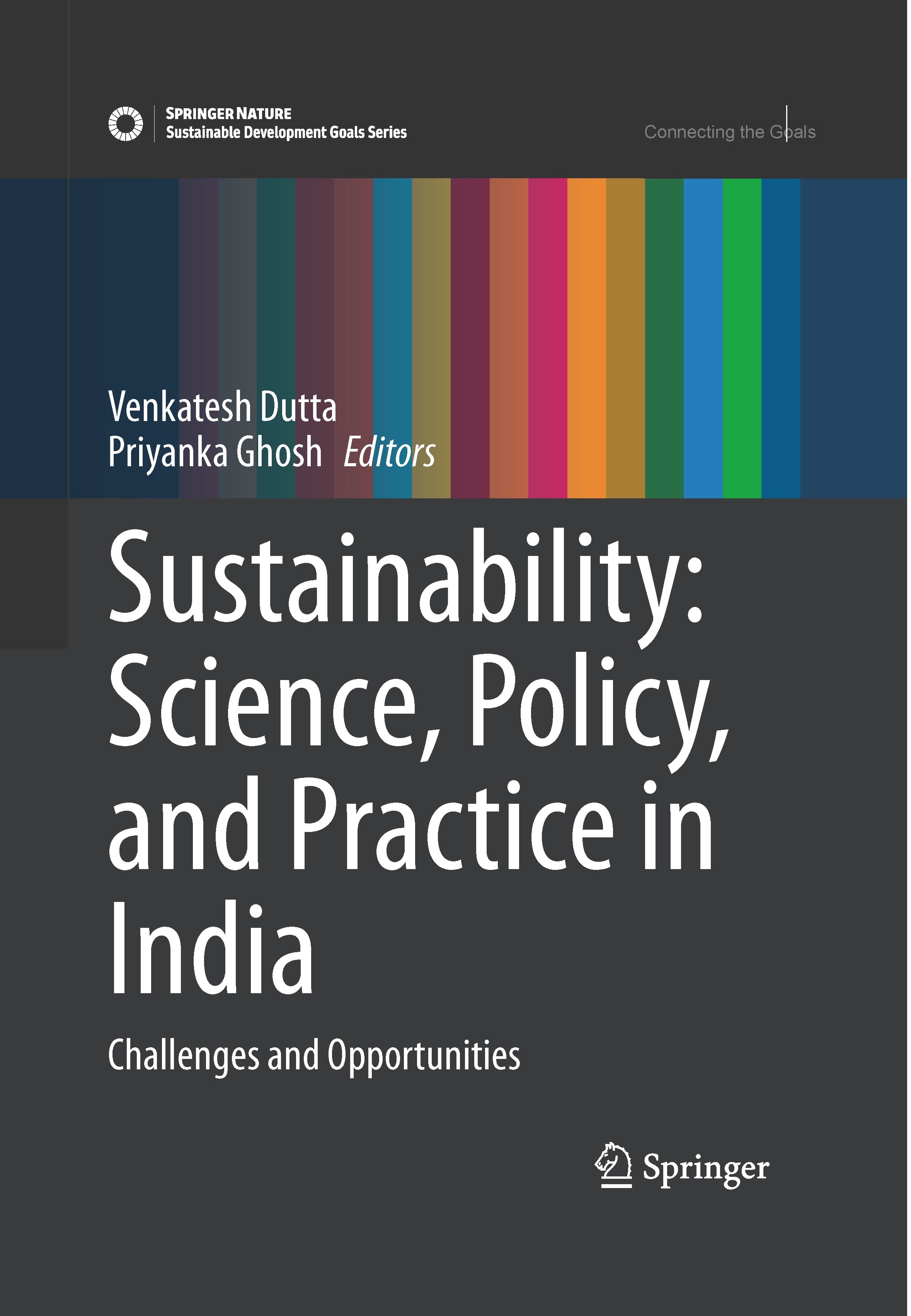
This book is an interdisciplinary work that reveals the contemporary sustainability narratives in India within the context of various SDGs. Several case studies are presented, each of which sheds light on the challenges and constraints that are impeding the process of achieving SDGs and investigates potential long-term answers to socio-economic and environmental issues. Through empirical case studies from different parts of India, the book explores the current status of achieving sustainable development goals in India. The volume immensely benefits scientists, researchers, policymakers and practitioners as it offers a thematic and comprehensive understanding of challenges associated with mainstreaming SDGs at national, sub-national, and micro scales in India.
Sustainability as the Development Paradigm: Evolving Frames and Interpretations
Venkatesh Dutta, Priyanka Ghosh
Poverty Alleviation with Sustainable Development in India
Ravi Patni
Summary Measures of Population Health: Healthy Life Expectancy in India in the Context of Sustainable Development
Shewli Shabnam, Nandita Saikia
Quality Education: Foundation for 16 SDGs
Apoorva Bhatnagar, Triguna Singh
Mapping the Provisions for Inclusive and Equitable Quality Education in the Indian Education Policy Documents: NEP 1968 to NEP 2020
Chasul Phogat
Impact of the Language of Instruction for STEM Subjects on Student Engagement, Motivation, and Further Learning: A Case Study in Maharashtra, India
Darshan Gaikwad, Jyotsna Akurathi, Mukund Nagarajan Rao
Clean Water and Universal Sanitation in an Era of Sustainable Development: Understanding the Challenges and Prospects for SDG 6 in the Ganga River Basin
Sya Buryn Kedzior
India’s Journey Toward Cleaner and Affordable Energy for Achieving SDG 7: Progress and Prospects
Anurag Piyamrao Wasnik
Fuelling Women Lives with LPG: A Sociological Study of Fuel Use Pattern Amidst Policy Intervention in Peri-Urban Areas of Uttar Pradesh
Manish K. Verma, Moni Chandra
Decent Work and Inclusion: Migrant Women Domestic Worker’s Search for a Better Life
Anindya Basu, Diotima Chattoraj
The Impact of SDG-11 on Building Sustainable Cities: PPP Project Scenarios for Urban Infrastructure Development in India
Nimisha Jha
Water-Sensitive Urban Design as a Driver for Accelerating Sustainable Urban Development in India
Rajiv Ranjan Mishra, Jyoti Verma, Manju Rajeev Kanchan
SDG 13 and Climate Change in India
Tania Chakravarty, Priyanka Ghosh
Unsustainable, Imperial Dreams: What India’s Blue Economy Portends for “Life Below Water”
Adam Jadhav
Reinventing Methods of Preserving and Protecting Forests of India with Particular Reference to Odisha
Swetaparna Ankita
Green Diplomacy: A Way to Achieve SDG-17
S. Venkata Krishnan
Sustainable Development Goals: Challenges, Opportunities, and the Way Forward
Priyanka Ghosh, Tania Chakravarty
Priyanka Ghosh is a Senior Assistant Professor of Geography
at the School of Social Sciences and Humanities, Vellore Institute of
Technology (VIT)-AP, India. Her areas of interests are political ecology,
biodiversity conservation, protected area management, and sustainable
development. She has extensively worked in the Indian Sundarbans during her
Ph.D. at the University of Kentucky and later extended her research by
investigating the rural land use of Fayette County, Kentucky. She has served as
an educational advisor at the IEC Kumamoto International College, Japan for
five months. Dr Ghosh has published high-ranking peer-reviewed international
and national journals such as Geographical Review, GeoJournal as well as
contributed book chapters on several issues such as water shortage and water
crisis in large cities of India, street and place name changes in Kolkata, and subsistence
and biodiversity conservation in the Indian Sundarbans. Venkatesh Dutta is Professor of Environmental Sciences in a
Central University (Babasaheb Bhimrao Ambedkar University, Lucknow). He is
trained as Environmental Management Specialist with specialization in Water
Resources Management. His main research interests include River Restoration,
Land-use planning along with zoning regulations, Environmental Impact
Assessment, Urban Policies and Sustainable Cities. He is also interested in
spatial patterns, process, cause and consequence of urban sprawl vis-a-vis
environmental impacts.

Shruti Mathur and Rajendra Kumar
Your cart is empty.