
Jaipur • New Delhi • Bengaluru • Guwahati • Kolkata
Swapna Banerjee-Guha (Ed.)
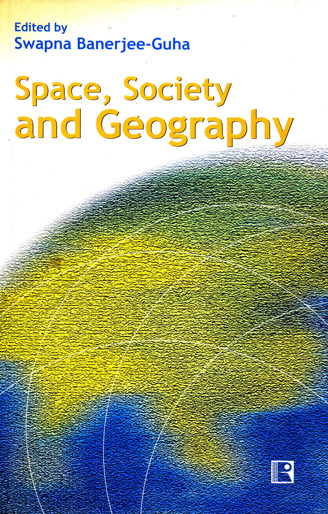
Since 1970s, through various human geographical works, not only society and space got juxtaposed to each other, but the imperative to embed space in understanding social processes was also reinforced. Contemporary researches in human geography have proved that social relations are both constituted through and constrained by space, giving rise in the process to a socio-spatial dialectic. It is not only that space is a social construct, but that social relations are also constructed over space.
With this background, the book explores the trend that has set in India in contemporary human geographical researches and builds up a perspective of society-space convergence. Divided into two parts, containing theory and perspective in the first, and analysis in the second, the book has focussed on the major shifts and developments in the discipline: the impact of globalisation, post-Fordism, postmodernism, the cultural turn of gender studies, studies on languages and communal strife, environment and well-being, social infrastructure and social change. They stem from debates, movements and policies having their origin outside geography as well. It is in this context the book becomes significant in linking the debates of the wider body of social science with geography.
Swapna Banerjee-Guha, Professor of Human Geography at the University of Mumbai received her initial training in Geography from Calcutta University. A Postdoctoral Fulbright Fellow at the Johns Hopkins University in the United States, Prof. Banerjee-Guha has been a Visiting Professor in the University of Vienna, Visiting Fellow at the Institute of Developing Economies, Japan and a Visiting Fellow at the Maison des Science de L’ homme, Paris. She has been a regular contributor to books and journals at home and abroad and has a number of books to her credit. Her focus of research is urban, social and development geography.


Shruti Mathur and Rajendra Kumar


Your cart is empty.