
Jaipur • New Delhi • Bengaluru • Guwahati • Kolkata
Waquar Ahmed | Amitabh Kundu | Richard Peet (Eds.)
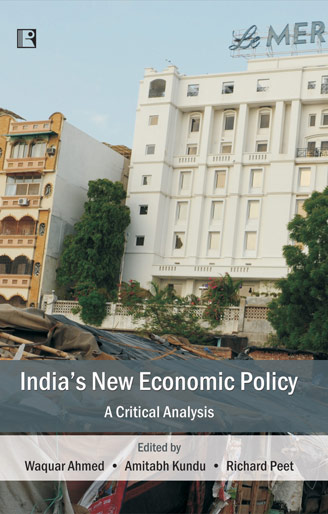
Introduction / WAQUAR AHMED, AMITABH KUNDU, AND RICHARD PEET
1. Neoliberalism, Inequality, and Development / RICHARD PEET
2. From Mixed Economy to Neoliberalism: Class and Caste in India’s Policy Transition / WAQUAR AHMED
3. Urban System in India: Trends, Economic Base, Governance, and a Perspective of Growth under Globalization / AMITABH KUNDU
4. New Urbanism, Neoliberalism, and Urban Restructuring in Mumbai / SWAPNA BANERJEE-GUHA
6. The Right to Waste: Informal Sector Recyclers and Struggles for Social
Justice in Post-Reform Urban India
7. From Red Tape to Red Carpet? Violent Narratives of Neoliberalizing Ahmedabad / IPSITA CHATTERJEE
8. Neoliberalism, Environmentalism, and Urban Politics in Delhi / ROHIT NEGI
9. Coping with Challenges to Food Security: Climate Change, Biofuels, and GMOs / SUMAN SAHAI
10. Imperialism, Resources, and Food Security, with Reference to the Indian Experience / UTSA PATNAIK
11. Special Economic Zones: Space, Law, and Dispossession / RUPAL OZA
12. Thinking Militant Particularisms Politically: Resistances to Neoliberalism in India / DAVID FEATHERSTONE
Waquar Ahmed is a visiting assistant professor at the Department of Geography, Mount Holyoke College, Massachusetts. Amitabh Kundu is professor of economics at the Jawaharlal Nehru University, New Delhi. Richard Peet is professor of geography at the Graduate School of Geography, Clark University, Worcester, Massachusetts.


Lynda Cheshire, Vaughan Higgins and Geoffrey Lawrence (eds)

Your cart is empty.
