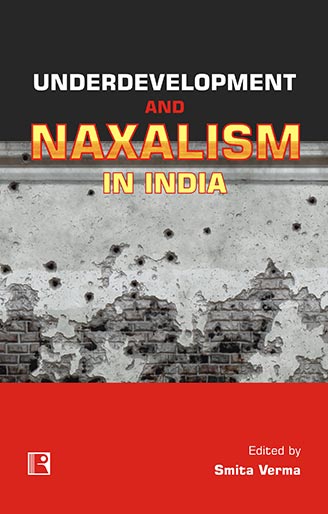
About the Book
Development in India has been lopsided and uneven. Despite best efforts, the government has been unable to contain inequality, poverty and unjust distribution of resources. A gaping difference exists between the two worlds of the haves and the have-nots.
Underdevelopment and Naxalism in India focuses on the contradictions of the Indian democracy, the disparities, and the perpetual marginalization of the backward states, taking hypothetical stance that such disparities have adverse effects. One such menacing fallout has been the ‘Naxalite Movement’. This movement thrives on the dissatisfaction of the marginalized and alienated population. Starting out as a small peasant movement in Naxalbari, West Bengal, Naxalism is now a pervasive, violent, and lethal insurgency. This decades-old uprising of the poor, the oppressed, the landless, and the deprived has seen a host of changes, and now serious questions are being raised over its ideological roots.
In the light of such tortuous social, economic, and political conditions, the contributing authors of this volume discuss underdevelopment and Naxalism at micro and macro levels – understanding, reasoning, and studying the nature of the issues and the circumstances. This intellectual and cogent discourse is an attempt to look for a solution to the contentious issue and brings to the forefront the dilemmas, the pain, and the resent of the deprived people.
Contents
1 Discourse on Underdevelopment and Naxalism: An Introduction / Smita Verma
2 Youth, Naxalism, and Terrorism: The Politics of Development in Indian Subcontinent / Felix Padel
3 Terrorism Interrogated: Naxalism to Maoism / Partha Nath Mukherji
4 Social Roots of Terrorism: A Critical Appraisal of Maoist Movement in India / Biswajit Ghosh
5 Development Paradigms and Naxalism: Resource, Development, and Indigenous People / Bikramaditya Kumar Choudhary
6 Maoists’ Tactical United Front (TUF) and Urban Movement / P.V. Ramana
7 Women and the Naxal Movement: Retrospect and Prospect / Rajat Kumar Kujur
8 Contemporary Social Movements in Tribal Regions of Central India / S.N. Chaudhary
9 Naxalism and the Problems of Development of Tribes / S.N. Tripathy
10 Securitization, Exceptions and Suspects: The Case of State-Maoist Interface in India / Mohammed Sirajuddeen
11 Origin and Growth of Left-Wing Extremism in Schedule Tribes Dominated Areas of Central India / Rajneesh Kumar Gupta
12 Role of Media in Reporting Terrorism in India: Perspective of Complicity between Media and Terrorists / Pallav Mukhopadhyay
About the Author / Editor
Smita Verma is Associate Professor and Head of the P.G. Department of Sociology and Women Studies, Isabella Thoburn College, Lucknow. She completed her higher studies from Jawaharlal Nehru University, Delhi. She was an IASACT Fellow in Hong Kong and also a Visiting Fellow under UGC-SAP at Babasaheb Bhimrao Ambedkar University, Lucknow. She also served as a consultant to a project jointly conducted by UNICEF and Government of India.
Her research interests are gender across lifespan, higher education, youth and globalization and social gerontology. She has published three books: Directions in Sociological Theory: Disputes, Discourses and Orientations (co-author), Ageing among Elderly Middle Class in Urban India: Reflections on Issues and Challenges, and Labour Migration in the Context of Globalization: Challenges and Perspectives (co-editor). She has also published numerous research papers, including book reviews.